Routine guide
Copper peptide
routine.
The topical form is the one with the research behind it. Here is how to fit it into a routine without wasting it.
The short answer
Copper peptide means GHK-Cu, a copper-binding tripeptide your body already makes and makes less of with age. On skin it has decades of cosmetic research behind it, most of it built on a wound repair story: in laboratory and animal models GHK-Cu stimulates collagen and glycosaminoglycan production and attracts the cells that rebuild tissue. In controlled cosmetic studies that shows up as modest improvements in firmness, skin density and fine lines over weeks to months. It is a slow, cumulative active, not an overnight one.
What the data supports
- Repair signaling is the core claim. GHK-Cu was first studied for wound healing, and that is where the mechanism work lives — collagen synthesis, remodeling enzymes, antioxidant activity, recruitment of repair cells. Cosmetic use borrows a healing pathway and applies it to intact skin.
- Firmness and fine lines, modestly. Controlled studies of copper peptide products have reported improvements in skin density, roughness, firmness and fine lines. Many are small and industry-linked, so the honest reading is supportive rather than definitive.
- Post-procedure skin is a natural fit. Because the evidence is repair-shaped, copper peptides are a common recommendation for skin recovering from microneedling or laser work. Timing after a procedure is a decision for whoever performed it.
- Tolerance is generally good. Most complaints are redness, stinging or dryness, and most of those come from layering it with something aggressive rather than from the peptide itself.
- It does not exfoliate or bleach. Copper peptides do not resurface skin, fade pigment or replace sunscreen. Nothing in the record supports those uses.
Strength and the blue test
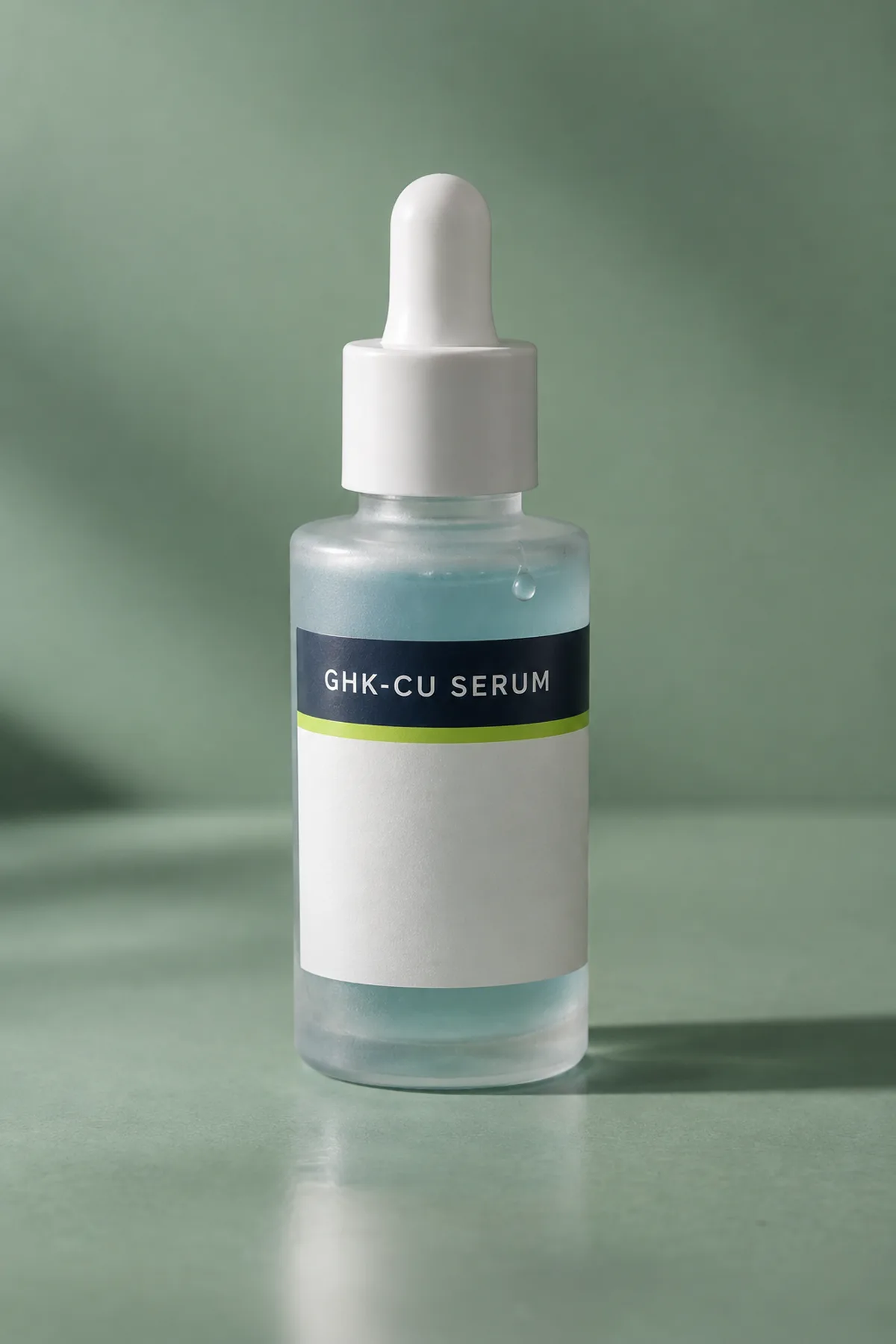
Copper complexes are blue. A genuine GHK-Cu serum at a meaningful concentration is tinted blue to blue-green, and that color is the cheapest sanity check you have at the counter. A water-clear serum claiming copper peptides is either at a concentration too low to color the bottle or is using something other than the copper complex.
The color test proves presence, not dose. Products in this category typically sit in low single-digit percentages, and a brand confident in its formula will print the actual concentration rather than hide the peptide inside a proprietary blend near the end of the ingredient list. More is not automatically better either — higher strengths are associated with more irritation, and the studies that reported results did not use heroic doses.
Where it goes in a routine
Evening is the default, for one practical reason: it keeps copper peptides away from the actives most likely to conflict with them, which people usually apply in the morning. Order matters less than contact — cleanse, apply the copper peptide serum to damp or dry skin, wait a couple of minutes, then moisturize.
- Evening routine — cleanser, copper peptide serum, moisturizer. Simple and the easiest to keep up for the three months it takes to judge.
- Morning use — perfectly workable if your morning is otherwise gentle, meaning no high-strength vitamin C and no acids. Sunscreen still goes last, every day.
- Alternating nights — the usual answer when you also use a retinoid. Copper peptides one night, retinoid the next, rather than stacking both on the same irritated face.
- Give it a season. The studies that found a change ran weeks to months. Judging a copper peptide serum after two weeks tells you nothing except whether it stings.
The conflict debate
You will read that copper peptides cannot be used with vitamin C or retinoids. The truthful version is narrower and worth understanding, because it changes what you do about it.
The vitamin C concern is chemical and specific to formulation. High-strength L-ascorbic acid is a strong reducing agent formulated at low pH, and copper is a redox-active metal. Put the two in contact wet on wet and you can destabilize the copper complex and degrade the vitamin C at the same time — the interaction is between a particular acid and a particular metal complex in a particular formulation, not between all forms of vitamin C and all copper products. Derivatives buffered at a higher pH are far less of a problem. The practical fix is simple and costs nothing: vitamin C in the morning, copper peptides at night.
The retinoid concern is different and mostly about your skin rather than the chemistry. Retinoids drive cell turnover and are irritating on their own, and copper peptides applied on top of freshly retinized skin increase the chance of redness and stinging. There is no strong evidence that one deactivates the other. Alternate nights, or separate them by a full routine, and most people tolerate both.
The same reasoning applies to acids. Glycolic, salicylic and lactic acid formulations are low pH environments, so keep them in a different session rather than in the same layer.
What about hair
Copper peptides turn up in scalp serums, and the interest is genuine rather than invented — the follicle work exists, but it is largely preclinical models and small formulation studies rather than the kind of trials that built the case for minoxidil. If hair is the actual goal, minoxidil still wins on data by a wide margin, and finasteride sits in the prescription conversation alongside it. Copper peptides are a reasonable add-on for scalp condition and a poor first choice for regrowth.
The injectable question
Everything above is about a serum. Injectable GHK-Cu is a separate product with a separate evidence base, and that base is close to empty — no randomized human trial establishes what subcutaneous copper peptide does to skin, joints or anything else, and there is no approved product, which means vials come from the research chemical market with no verification of purity, sterility or copper ratio. Repeated systemic copper also matters medically in a way that a serum never does.
The gap between the two forms is wider here than for almost any other peptide, and good data on a cream does not make a vial with none any safer.
Questions people ask
What do copper peptides do for skin?
Can I use copper peptides with retinol?
Can I use copper peptides with vitamin C?
Do copper peptides regrow hair?
How long until copper peptides show results?
Sources: PubMed — copper tripeptide and skin · PubMed — GHK and wound healing · FDA — cosmetic ingredients