Peptide FAQ
Every question,
answered.
The questions people actually type into Google about peptides, answered without a sales pitch attached.
Reviewed for medical accuracy · Sources at the end of this page
We sell nothing, we take no vendor money, and we say unknown when the evidence is missing. Open any question below.
Peptide basics
What does taking peptides do for you?
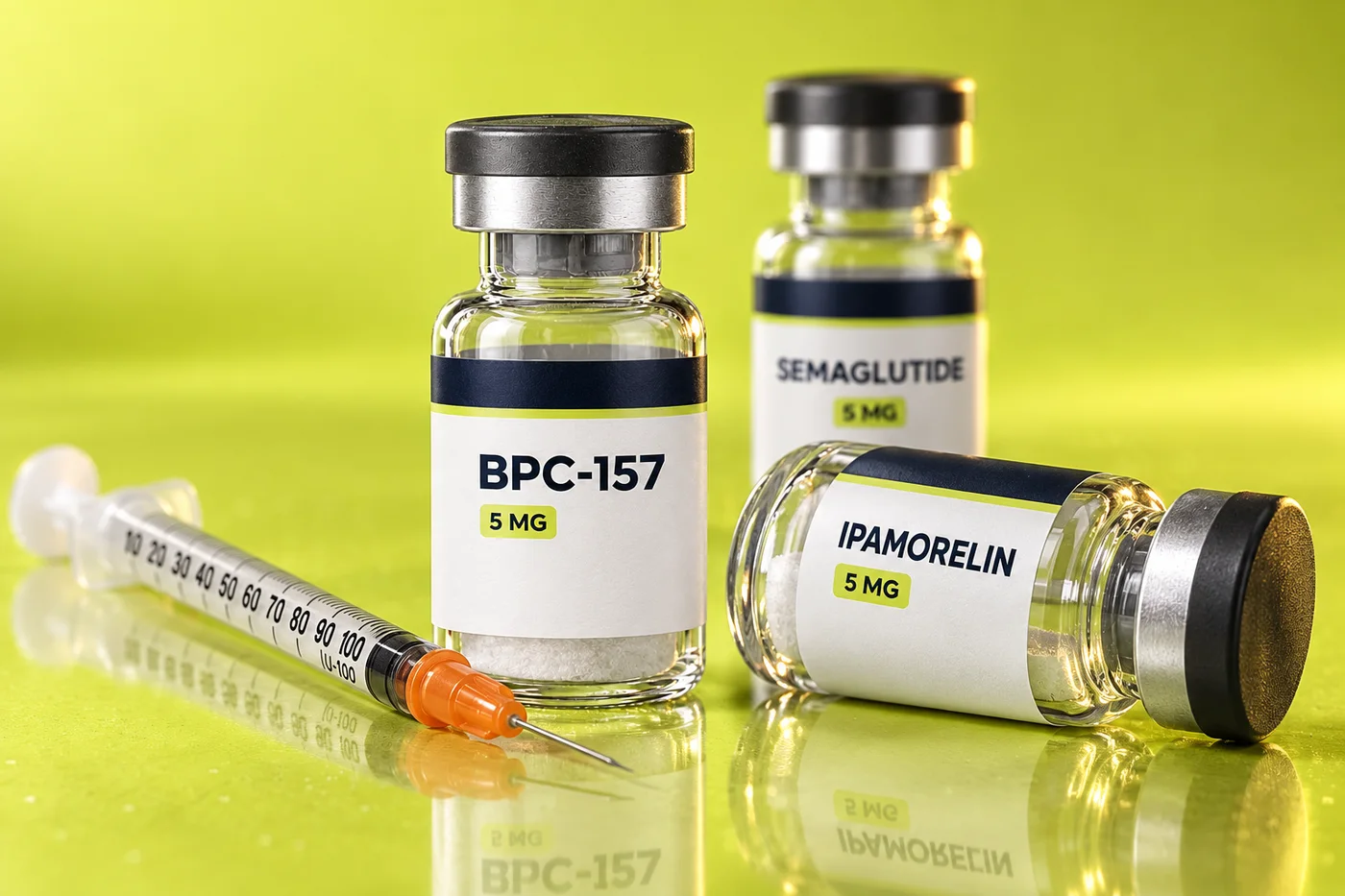
It depends entirely on the molecule, because peptide is a category rather than a drug. GLP-1 peptides such as semaglutide and tirzepatide reduce appetite and produce documented weight loss, which the weight loss guide covers in detail. Growth hormone secretagogues such as sermorelin and ipamorelin nudge your own growth hormone pulses and are marketed for sleep, recovery and body composition on much thinner human evidence. Repair peptides like BPC-157 have three decades of animal data and no completed human trial.
Do peptide injections really work?
Some do, with large randomized trials behind them. GLP-1 medicines changed obesity care, and peptide drugs such as tesamorelin and bremelanotide cleared FDA review for their specific indications. Most peptides sold online for recovery, anti-aging and muscle have never been through an adequate human trial, so the honest answer for those is unknown rather than yes.
What are the top 5 peptides?
By search interest rather than evidence, the five people ask about most are BPC-157, semaglutide, tirzepatide, sermorelin and ipamorelin. Ranked by human data the list shrinks fast, because the GLP-1 medicines carry the trial evidence and the rest rest on animal work, small studies and clinic experience. Combining them is a separate question, handled in the stacks guide. Which one belongs in your plan, if any, is a decision for a licensed physician.
Do peptides qualify as steroids?
No. Anabolic steroids are synthetic relatives of testosterone that bind hormone receptors directly. Peptides are short chains of amino acids, and the popular ones work upstream by signaling your own body to release a hormone, or by acting on an entirely different receptor. The legal categories differ too: anabolic steroids are Schedule III controlled substances in the United States, while most peptides are not scheduled.
Which is better, peptides or steroids?
They are not two versions of the same thing, so better does not apply cleanly. Anabolic steroids reliably build muscle and carry a well-documented list of cardiovascular, hormonal and liver risks. Growth hormone peptides produce far smaller changes in body composition and have far less human outcome data, which means both less proven benefit and less measured harm. Neither belongs in a self-directed plan, and the safety guide explains why.
Are peptides safer than TRT?
Nobody can answer that with data, because no trial has compared them head to head. Testosterone replacement has decades of monitoring behind it, with known effects on fertility, red blood cell count and cardiovascular markers and clear lab targets to follow. Peptide protocols have thinner safety records, which reads as safer only because far less has been measured. Both are prescription medicine and both need blood work and a physician.
Safety and side effects
What is the risk of taking peptides?
There are two separate risks and people usually worry about the smaller one. The molecule can bring side effects: fluid retention, joint ache and a drift in blood sugar with growth hormone peptides, nausea and muscle loss without resistance training with GLP-1 medicines. The larger and more measurable risk is the product, because independent testing of gray-market vials has repeatedly turned up wrong doses, impurities and bacterial contamination. The safety guide goes through both in depth.
What is the safest peptide to take?
The safest peptide is an approved one, prescribed for its approved use and monitored with labs. Among the peptides discussed on this site, the GLP-1 medicines, tesamorelin and bremelanotide are the ones with FDA approval and a real safety file behind them. For anything sold as research material there is no safety file to rank, so the question has no honest winner. A physician decides what is safe for you specifically, based on your history.
Why don't doctors like peptides?
Most physicians are not hostile to peptides, they are hostile to missing evidence. Prescribing outside FDA approval puts the liability on the prescriber, and for compounds without human trials there is no established dose, no monitoring plan and no published safety data to stand on. Add the FDA flagging several popular peptides as bulk substances that may present significant safety risks in compounding, and the caution is professional rather than personal.
Will peptides fail a drug test?
For a workplace panel, no. Standard tests look for drugs of abuse and do not screen for peptides. For tested athletes the answer flips completely: growth hormone secretagogues, BPC-157 and similar compounds are prohibited under the World Anti-Doping Agency list, and athletes have been sanctioned for them. If you compete under any anti-doping code, assume a peptide is detectable and ask before you inject anything.
How long does a peptide injection last?
That depends on the half-life of the molecule, not on how long you feel something. Short peptides such as ipamorelin and BPC-157 clear within hours, which is why protocols call for daily or twice-daily dosing. Engineered versions such as CJC-1295 with DAC and the GLP-1 medicines are built to last days and are dosed weekly. If you are working out units on an insulin syringe, the dose calculator does the reconstitution math.
Buying and the law
Can I just buy peptides?
Vials are easy to find online under a research use only label, so buying is simple in practice. What you are buying is material sold outside medical regulation, with no pharmacist, no physician and no guarantee about strength, purity or sterility. The lawful route for human use runs through a prescription written by a licensed physician and filled by a named US pharmacy. The buying guide compares the channels honestly.
Can peptides be sold over the counter?
Not lawfully for human use. Approved peptide medicines are prescription drugs, and the FDA has stated that BPC-157 does not meet the definition of a dietary ingredient, which puts capsules marketed as supplements outside the rules. Products still appear on shelves and marketplaces, which tells you about enforcement rather than about legality.
Is it illegal to buy peptides online?
Selling a peptide as research material is generally legal. Selling it for human use without FDA approval is not, and marketing it with dosing advice for people crosses that line. Buyers are rarely the enforcement target, but the buyer carries the real consequence, which is an unregulated injection with no recourse if something is wrong with it. Importing quantities can also draw customs attention.
What is the most legit peptide company?
We do not rank vendors, we are not paid by any of them, and no name will appear here as a recommendation or as a warning. What we can give you is the test: a legitimate service names its physicians and the US pharmacy that fills your order, reviews you medically before taking payment, shows the full price up front and lets you cancel at any time. Judge any company against that list rather than against a review page it controls, and the buying guide expands it.
Do I need a prescription for peptide therapy?
Yes, for any legitimate route. A licensed physician reviews your history and labs, decides whether a peptide is appropriate at all, and writes the prescription a US pharmacy fills. A service that skips the medical review and goes straight to a checkout button is selling a product rather than treatment. The legal path walks through what that process looks like.
Cost and value
How much does peptide therapy cost?
Typical advertised US telehealth prices run roughly 150 to 350 dollars a month for growth hormone peptide protocols and roughly 200 to 400 dollars a month for compounded GLP-1 programs. Brand-name Wegovy or Zepbound paid in cash is advertised near 1000 to 1350 dollars a month, often much less with manufacturer savings programs. Consults and lab panels are frequently billed on top, commonly 100 to 300 dollars for the initial bloodwork. The cost guide breaks down what moves those numbers.
How much do 3 months of peptides cost?
At those advertised rates a three month course lands near 450 to 1050 dollars for a growth hormone protocol and near 600 to 1200 dollars for a compounded GLP-1 program, plus labs. Quarterly prepay is usually discounted, which is a saving only if the therapy turns out to be right for you. How long a course should run is a clinical decision, not a package deal.
Are peptide injections worth it?
It depends on the molecule and on what you expect from it. GLP-1 medicines buy an effect that was measured in large randomized trials, so the money is tied to documented results. Growth hormone peptides cost less and buy a smaller, slower change with far thinner human data behind it. Research peptides with no human trials are the weakest value of the three, because nobody can tell you what the vial is buying.
Celebrity peptide rumors
What peptides does Jennifer Aniston take?
Nobody outside her medical team knows, and that is the complete answer. No prescription has been published, and the lists that circulate come from tabloid coverage and from marketing that borrows a famous name to move product. Treat any protocol attributed to a celebrity as unverified. Judge a peptide by its trial data and by what a physician says about your own labs.
Where does Joe Rogan get his peptides?
His supply is not public, and a remark on a podcast is not a prescription or a source you can follow. The question usually leads people toward gray-market vendors who advertise the association, which is how a passing curiosity turns into an unregulated injection. If a compound genuinely interests you, bring the evidence to a physician and start from the legal path.
What peptides do celebrities use?
Named celebrity protocols are tabloid material rather than medical records, and the people involved have not published what they take. Clinics, trainers and vendors repeat the stories because a famous name sells vials. The versions ordinary buyers can get without a prescription come from the gray market, where independent testing keeps finding wrong doses and contamination. Start from the evidence instead, and let a physician decide what fits you.
Sources: FDA — bulk substances safety list · FTC — health products compliance guidance · PubMed — therapeutic peptide literature