Buying guide
Where to buy,
without regret.
Three channels sell peptides in the United States. Only one of them is medicine. Here is how to tell them apart before you pay.
The short answer
We name no vendors, positively or negatively, and we take no money from any of them. What follows is a way to read a seller instead of a list to trust. One channel puts a licensed physician and a named US pharmacy between you and the vial. One sells the same molecules as research material with no regulator checking what is inside. One is a scam with a shipping label. The price difference between them is real but smaller than it looks, and the difference in what you actually receive is enormous.
The three channels
- Licensed telehealth — a physician licensed in your state reviews your history and labs, decides whether a peptide is appropriate, and writes a prescription that a named US 503A or 503B pharmacy fills and ships cold-chain. This is the legal and monitored route, and the only one where someone is accountable for what arrives.
- Gray research-chemical vendors — websites that sell lyophilized peptides under a research use only label. Selling research material is generally lawful; the material itself is unregulated, and independent testing has repeatedly found wrong doses, impurities and contamination. Nobody is checking sterility for injection, and you carry the entire risk yourself.
- Counterfeit and social-media sellers — direct messages, group chats, marketplace listings and gym contacts. This tier includes relabeled vials, refilled vials and vials that never shipped at all. There is no seller to complain to, no lot to trace and no possibility of a refund.
The licensed route
What you pay for here is not only the molecule. It is a medical review that can tell you no, a pharmacy with a state license and inspection history, a lot number and an expiry date on the label, cold-chain handling, dose adjustments as the protocol escalates, and a clinician who answers when something feels wrong. The monthly price sits higher than a gray vial for exactly those reasons. It is also the only channel where a bad batch has a traceable owner.
The gray market
Research use only is a legal disclaimer, not a quality standard. It means the seller is not claiming the material is fit for people, which is precisely the protection they need and precisely the protection you do not get. A vendor can be entirely lawful in how it sells and still ship a vial with the wrong amount of peptide, residual solvents from synthesis, or bacterial endotoxin that no purity number would reveal. The molecule on the label may even be correct while the dose is not, which turns a protocol into guesswork and makes any result impossible to interpret.
People choose this channel for price and for access to compounds no pharmacy will prepare. That trade is worth naming plainly: you are exchanging every layer of quality control for a lower sticker price, and injecting the result.
The counterfeit tier
The lowest tier does not pretend to be research supply. It lives in direct messages, private groups and marketplace listings, takes crypto or a payment app, ships from nowhere in particular and disappears when questioned. Vials arrive without lot numbers, without expiry dates and sometimes without any peptide at all. Testing has found unrelated substances in products sold this way. There is no version of this channel that is worth the saving.
A checkout you can trust
- Full price shown before you enter a card, shipping included
- A physician reviews your intake before payment, not after
- The US pharmacy that fills the order is named in writing
- Cancel any time, with no locked term and no penalty
- A medical team that answers messages from real people
- Named clinicians whose state licenses you can verify yourself
- Consult and lab fees stated separately, not buried
Vendor red flags
- Research use only wording sitting next to human dosing advice
- No physician anywhere in the process before checkout
- Crypto-only payment, no company name, no physical address
- Guaranteed prescriptions or guaranteed results
- Prices far below every licensed pharmacy in the market
- Reviews that exist only on pages the seller controls
- Vials with no lot number, no expiry date, no storage instructions
- Pressure to buy a twelve month package before any bloodwork
The real price gap
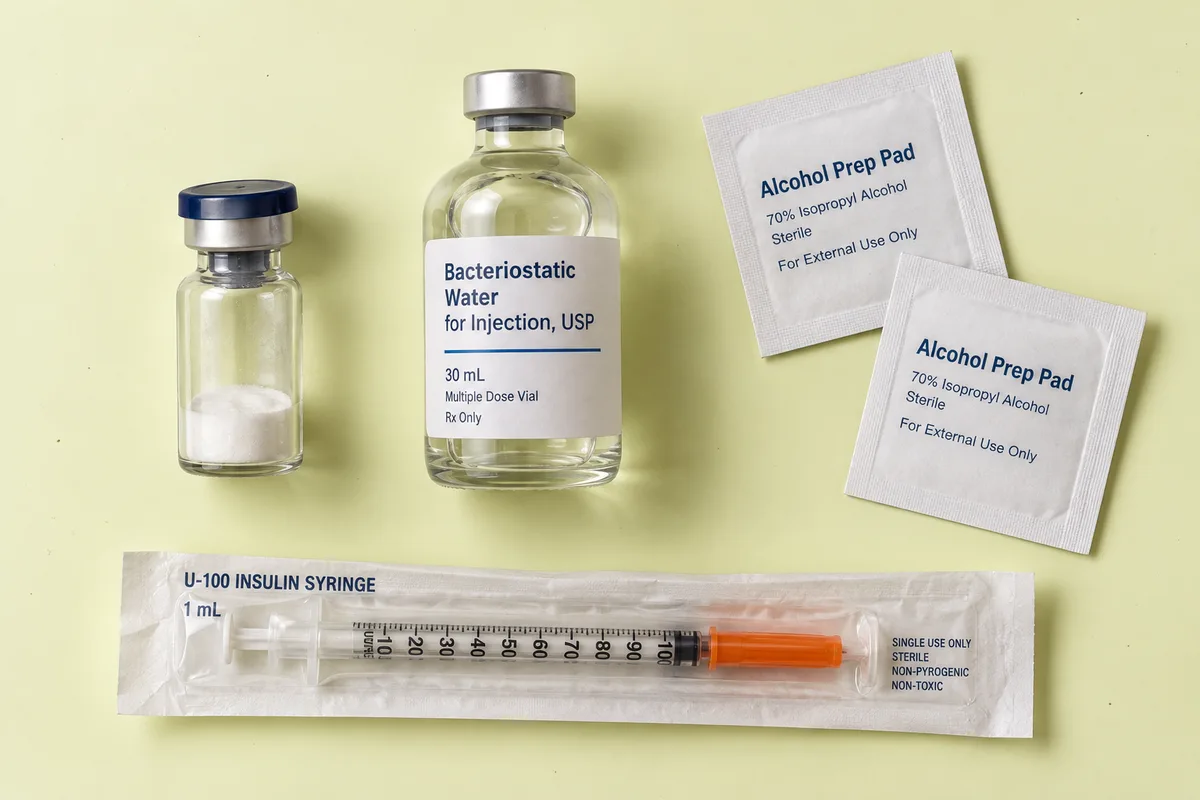
A gray vial can look like a fraction of a telehealth month, and on the sticker it is. Price what actually happens next. A vial of unknown strength produces an unknown dose, so a course that shows nothing tells you nothing and gets repeated. Bacteriostatic water, syringes, alcohol pads and shipping are yours to buy. Nobody adjusts the dose, and the labs you skipped are the ones a physician would have used to decide whether the peptide belonged in your plan at all. One wasted course and one lab panel close most of the gap on their own, and a single urgent care visit for an infected injection site erases it several times over. The cost guide lays out the advertised numbers on both sides.
The certificate myth
Almost every research vendor posts a certificate of analysis, and buyers read it as proof. It is not. The document is commissioned and hosted by the seller, which means the seller chooses whether to publish it and which one to publish. It describes a lot you cannot confirm your vial came from, and many circulating files carry no lab name, no signature and no date. Purity measured by chromatography says nothing about sterility, endotoxin, or what else ended up in the vial during filling. Third-party verification means an independent laboratory testing a product pulled off the market, with the result published by someone who does not profit from it. A PDF on a product page is marketing that looks like science.
The version of this that does exist is a licensed pharmacy, which is inspected, holds records for its preparations, and answers to a state board rather than to its own marketing team.
Questions people ask
Can I just buy peptides?
What stores can I buy peptides at?
Is it illegal to buy peptides online?
What is the most legit peptide company?
Can peptides be sold over the counter?
Sources: FDA — compounding questions and answers · FTC — health products compliance guidance · PubMed — peptide purity and contamination