Peptide guide
AOD-9604.
Failed, sold.
It was tested in people as an obesity drug, it did not work, and the vials are still on sale. Save your money.
The short answer
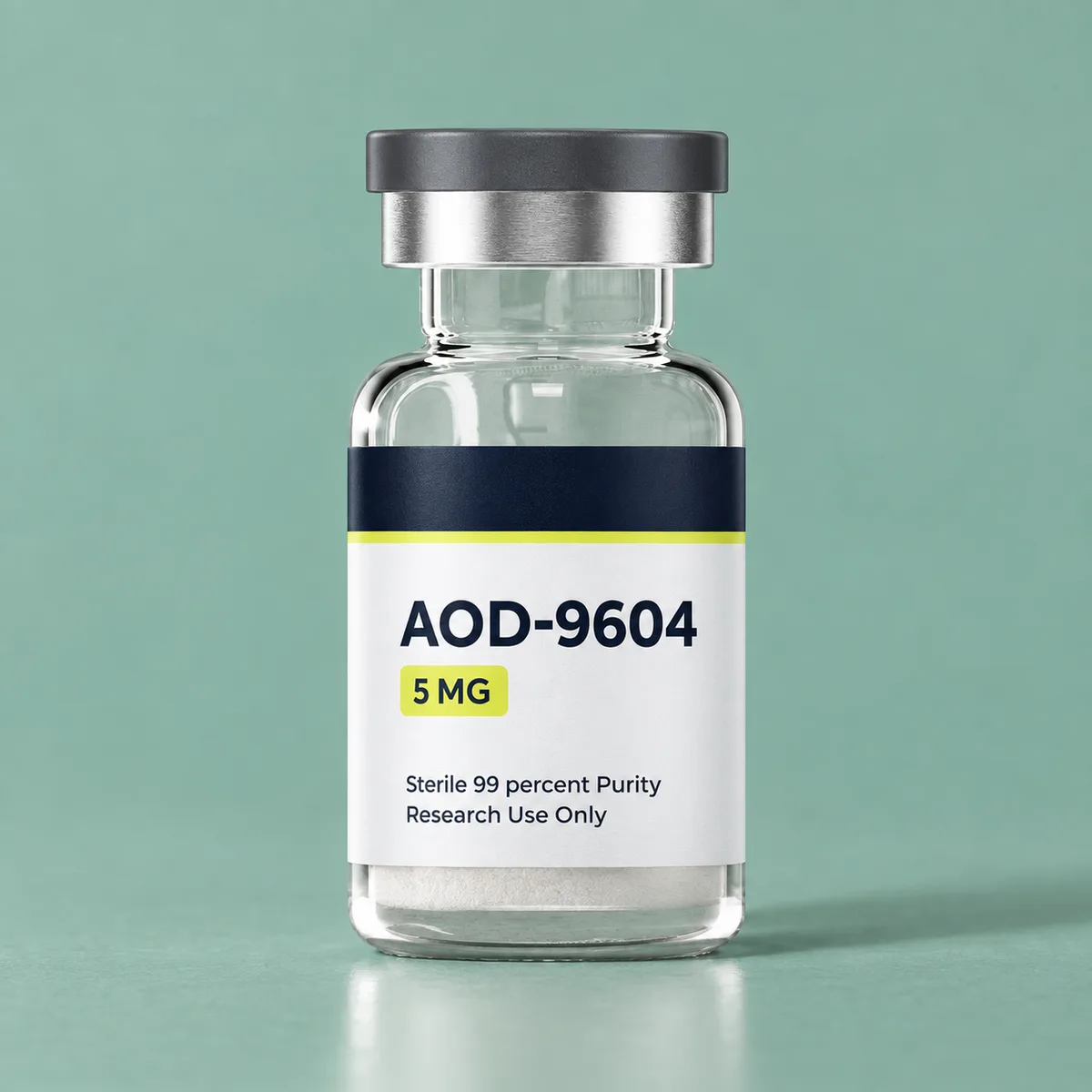
Most peptides on this site are unknowns. AOD-9604 is not. It is a fragment of human growth hormone, it was developed as an obesity drug by the Australian company Metabolic Pharmaceuticals, and unlike almost every research peptide in circulation it actually reached human trials in the 2000s. The result was the reason you have not seen it in a pharmacy: treated participants did not lose meaningfully more weight than participants on placebo. The obesity program was discontinued. Everything being sold today is the afterlife of a drug that already answered the question people are paying it to answer.
What the research shows
- Where it comes from — AOD-9604 is a short piece of the tail end of human growth hormone. The idea behind it was elegant: isolate the part of the hormone that laboratory work linked to fat breakdown, and leave behind the parts that drive tissue growth and interfere with blood sugar.
- Animal data — rodent work reported increased fat breakdown and reduced fat gain, and that is what justified taking the molecule into people. This is the stage where most research peptides stop. AOD-9604 went further.
- The human trials — company-sponsored obesity studies ran in the 2000s. Weight change in the treated arms was not meaningfully better than in the placebo arms, and the obesity development program was abandoned rather than advanced.
- What the trials did establish — tolerability. Dosing did not produce the blood sugar problems that limit growth hormone itself, and that safety impression is the part of the story vendors quote. A well tolerated compound that does not work is still a compound that does not work.
- Afterwards — the molecule has been examined for other uses, including joint and cartilage work, and none of that has produced an approved product anywhere. There is no later obesity trial that overturns the original result.
Why it is still sold
A failed drug is commercially attractive in the gray market for exactly the reasons it failed. The patent estate is old, the raw peptide is cheap to synthesize, the safety impression is reassuring, and the origin story is genuinely appealing — a fat-burning piece of growth hormone with the risky parts removed. None of that is fraud on its face. What is missing from the sales page is the sentence that the developer's own trials wrote.
It usually shows up bundled, not alone. Stacked with a growth hormone secretagogue, packaged into a clinic weight loss program, or added to an injection that also contains other ingredients, so that whatever the patient feels gets credited to the mix. That structure makes it very hard for a buyer to notice that one of the components has already been tested and returned a negative answer.
Dosing in practice
A physician decides whether anything belongs in your plan and at what dose. What follows describes what appears on labels and in reported clinic practice, so the units make sense when you read them, not as a recommendation.
Injectable protocols in circulation commonly sit around 300 micrograms once daily given subcutaneously, often in the morning, in courses of several weeks to a few months. Oral capsule products are labeled in a similar microgram range. Vials arrive as freeze-dried powder that must be reconstituted with bacteriostatic water, and microgram amounts translate into very small syringe markings, which is where dosing accidents happen. Understand the real issue here: the dose is not the weak point. The molecule was tested at doses chosen by the company developing it and still did not produce weight loss, so tuning the number is not a fix.
Side effects and risks
- Tolerability in the human studies looked unremarkable, and mild headache, tiredness and injection site redness are what users describe informally.
- Long-term human exposure is unmeasured. Trial participants were followed for months, not years, and nobody has tracked people using gray-market vials at all.
- Growth hormone fragments are prohibited in tested sport under the World Anti-Doping Agency list, so an athlete who uses this is risking a sanction for a compound that failed its own trials.
- Product risk — independent testing of gray-market peptide vials has repeatedly found wrong doses, impurities and contamination. That hazard applies here like everywhere else.
- The biggest cost is not medical. It is months of spending and attention aimed at a compound with a negative human result, while the actual problem goes untreated.
Legal and FDA status
AOD-9604 is not an approved drug in the United States for any condition, and it is not approved in Australia either, where it was developed. The FDA's dietary supplement ingredient directory lists it among ingredients that do not meet the definition of a dietary ingredient, so capsules marketed as supplements are outside the rules regardless of what the label says. Vials sold online carry a research use only disclaimer, which describes the seller's legal position and says nothing about purity, identity or sterility.
How people get it legally
There is no lawful prescription route to AOD-9604 in the United States, and this is one of the few pages where that matters less than usual, because the compound is not worth chasing. If the goal is fat loss, the useful step is a licensed physician who reviews your labs, your history and your medications, and tells you which of the approved options fits. That conversation also covers the compounds that do have landmark trial data behind them, and what they cost.
Questions people ask
Does AOD-9604 work for weight loss?
Why did AOD-9604 fail its trials?
Is AOD-9604 safe?
Why do clinics still sell AOD-9604?
What works instead of AOD-9604?
Sources: PubMed — AOD-9604 literature · ClinicalTrials.gov — AOD-9604 trial search · FDA — dietary supplement ingredient directory · WADA — prohibited list