Peptide guide
Retatrutide.
Not yet legal.
The strongest weight loss numbers ever reported in a trial, attached to a drug nobody can lawfully sell you.
The short answer
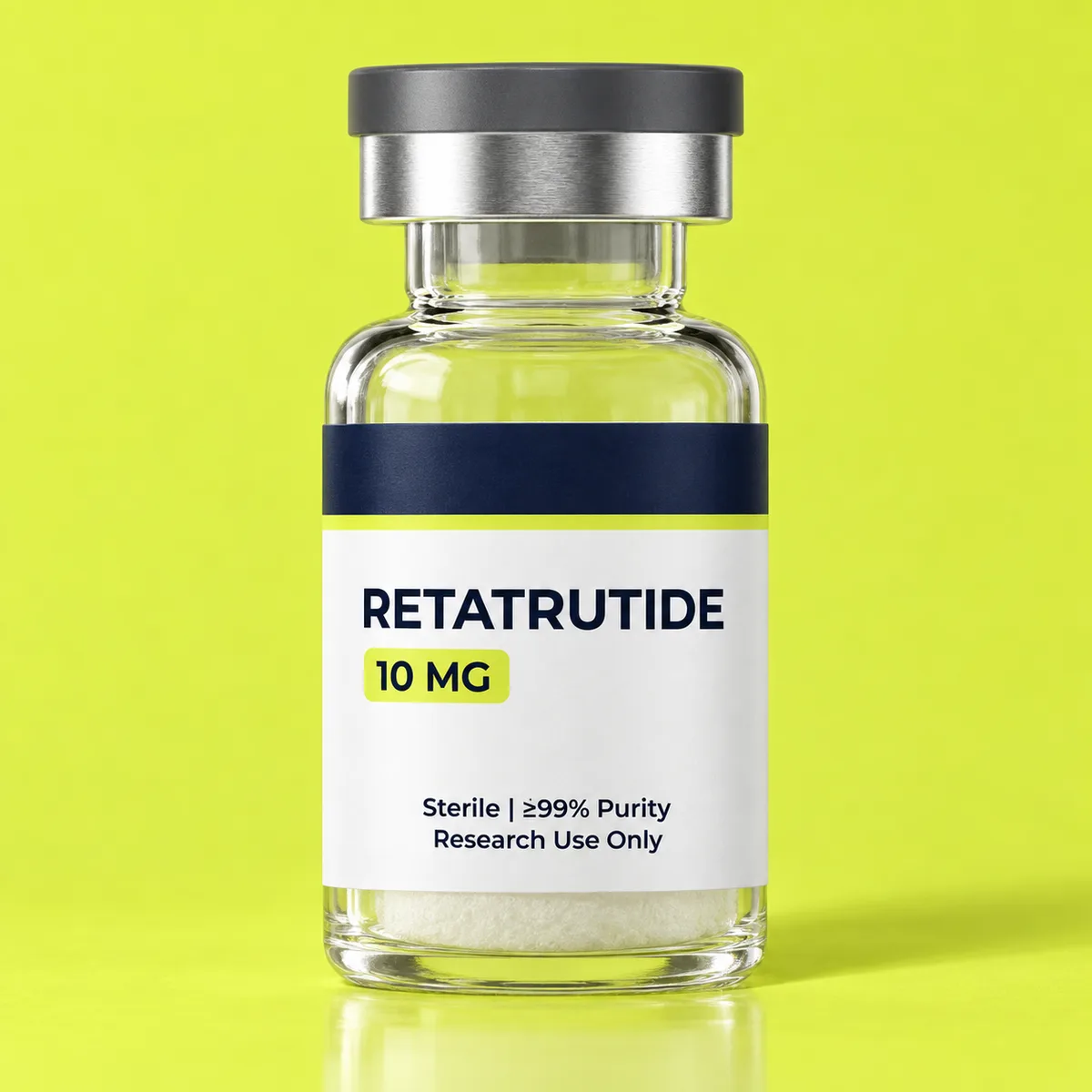
Retatrutide is an investigational drug that acts on three receptors at once, GIP, GLP-1 and glucagon. In its published phase 2 obesity trial it produced 24.2 percent mean body weight loss at 48 weeks at the highest dose, the largest result reported for any weight loss medicine to date. It is also not approved in the United States or in any other country, and it will not be until the phase 3 program finishes and regulators review it. Every website selling retatrutide today is selling an unregulated research chemical, and there is no version of that purchase that is legal, monitored or quality controlled.
What phase 2 showed
- The headline number — the published phase 2 obesity trial reported 24.2 percent mean body weight loss at 48 weeks on the highest dose, with a clear dose response below it. For comparison, tirzepatide reached 20.9 percent in phase 3 and semaglutide 14.9 percent.
- Why three receptors — GLP-1 and GIP signaling reduce appetite and improve how the body handles glucose, which is the tirzepatide model. Adding a glucagon agonist is intended to raise energy expenditure as well, so the drug works on both sides of the balance.
- Weight had not plateaued — the trial authors noted that weight was still trending down when the study period ended, which is part of why the result drew so much attention.
- What phase 2 is not — it is a mid-size study designed to find a dose and detect obvious problems. It is not the long, large trial that settles safety, cardiovascular outcomes and who should avoid the drug. That work is what phase 3 exists for.
Where the trials stand
The phase 3 program runs under the TRIUMPH name and covers obesity, obesity with knee osteoarthritis, obesity with cardiovascular disease and type 2 diabetes. Those studies are ongoing, and their results are what a regulator will read.
On timing, the only honest statement is a shape rather than a date. Nothing can be approved before phase 3 completes and a full submission is reviewed, and reviews take many months after that. Anyone quoting you a specific launch quarter is guessing, and vendors quote one because urgency sells vials.
Why you cannot buy it
An investigational drug has no approved manufacturer, no pharmacy supply chain and no prescription pathway. A licensed US pharmacy cannot compound it either, because compounding starts from an approved active ingredient and this one does not have that status anywhere in the world. So when a site offers retatrutide, whatever the checkout page looks like, what is actually being shipped is a powder made for the research chemical market.
What that means in practice is worth stating plainly. Nobody has verified the identity of the peptide in the vial, its purity, its strength or its sterility. Independent testing of gray-market peptide products has repeatedly found wrong doses, impurities and contamination. With a drug this potent, a mislabeled vial is not a wasted purchase, it is a dosing error at home with no physician, no titration schedule and no one monitoring blood sugar, hydration or vomiting. Buyers also have no recourse, because the seller was never operating inside a system that could be complained to.
What people take instead
Two drugs in the same family are approved today and can be prescribed legally. Tirzepatide is a dual GIP and GLP-1 agonist that reached 20.9 percent mean weight loss in its phase 3 obesity trial. Semaglutide is a GLP-1 agonist that reached 14.9 percent. Both require a physician, both are filled by a licensed pharmacy, both come with dose titration and follow-up, and both have safety records built from tens of thousands of patients.
That is the real comparison. It is not 24.2 percent against 20.9 percent, it is a supervised approved medicine against an unverified powder from an anonymous seller. Waiting for retatrutide costs nothing while an approved option is already available.
How to join a trial
Trial enrollment is the only lawful route to this drug, and it is free to explore. The public registry at clinicaltrials.gov lists every study by drug name, condition and location, with the enrollment criteria and a contact for each site. Searching retatrutide there shows which studies are recruiting near you and what they require, which is usually a body mass index threshold, an age range and specific conditions that either qualify or exclude you.
Your physician can help read the criteria and can refer you to a research center. Participants receive the study drug and the monitoring at no cost, and the trade is real: assignment is random, so you may receive placebo, and the schedule of visits and tests is demanding. It is still a better deal than an unlabeled vial.
Side effects seen so far
- Gastrointestinal effects dominated the phase 2 safety data, mainly nausea, vomiting, diarrhea and constipation, mostly mild to moderate and more common as the dose was raised.
- Slow dose escalation is how this class of drug is managed, which is precisely what does not happen when someone doses themselves from a research vial.
- Heart rate increases have been observed across this drug class and are part of what long trials are designed to characterize.
- Muscle loss alongside fat loss is a known issue with rapid weight reduction, which is why protein intake and resistance training belong in any supervised plan.
- The full safety picture, including who should never take it, does not exist yet. That is not a gap the internet can fill in.
Questions people ask
Is retatrutide the same as Ozempic?
Is retatrutide better than Mounjaro?
Is retatrutide a fat burner?
Can you buy retatrutide legally?
What to avoid on retatrutide?
Sources: NEJM — retatrutide phase 2 trial · ClinicalTrials.gov — retatrutide studies · PubMed — retatrutide literature · FDA on non-approved GLP-1 products