Stack guide
BPC-157 and
TB-500.
The healing pair every forum recommends, held up against the evidence that actually exists.
The short answer
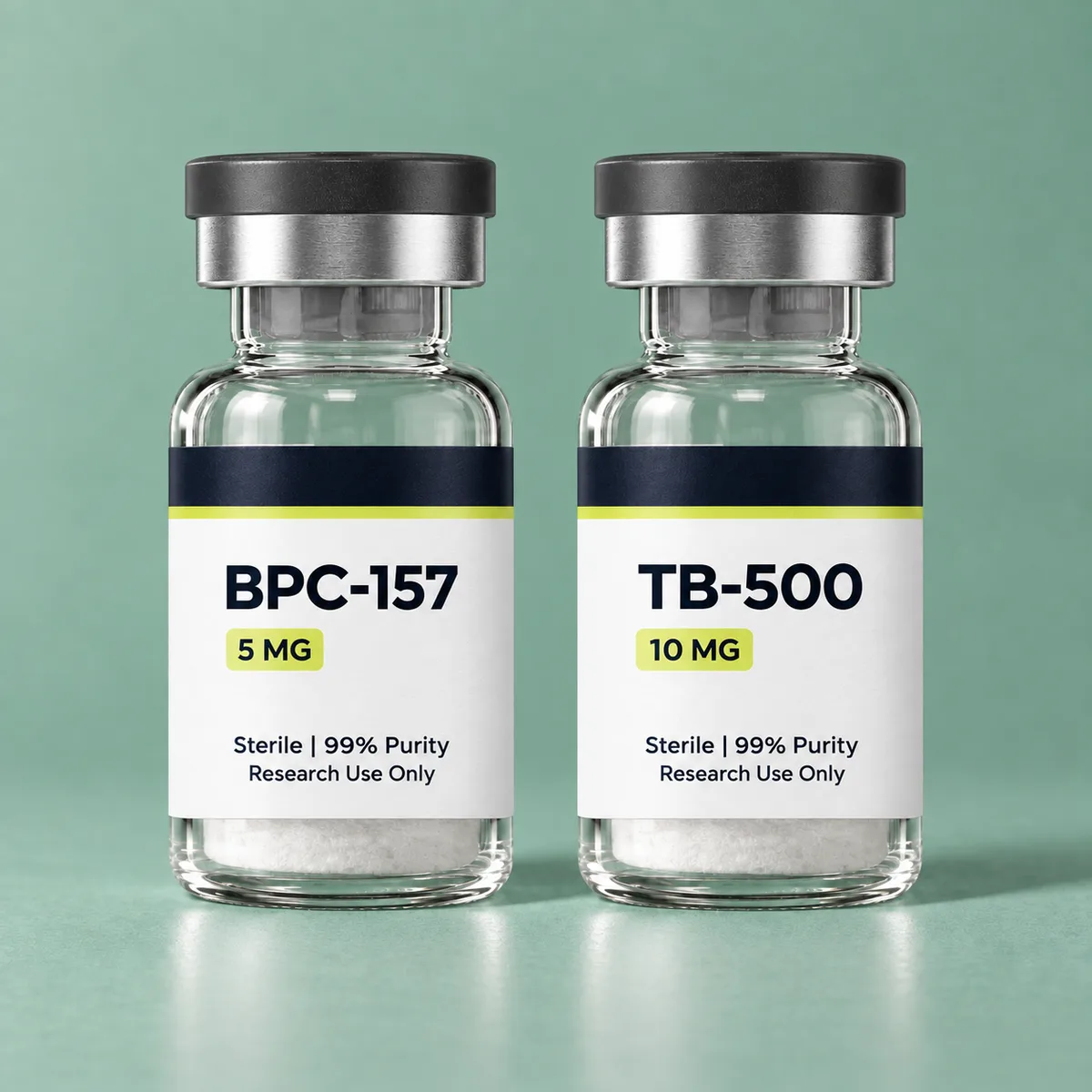
This is the recovery stack, the one people reach for after a tendon tear, a stubborn shoulder or a hamstring that keeps coming back. The logic behind the pairing is easy to follow and the evidence behind it is thin in a very specific way. Everything published on both compounds is animal work. Neither has a completed human trial on its own, so there is certainly no trial of the two together, no interaction data and no safety monitoring of the combination in any population. Both are unapproved in the United States and both are banned at all times in tested sport.
The rationale
The two compounds are described as working on different parts of the same repair process, which is why they are sold as partners rather than rivals. BPC-157 is a synthetic fifteen amino acid sequence derived from a protein found in human gastric juice, and three decades of rodent work point to new blood vessel formation and to protection and healing of gut tissue. Better blood supply to an injury is the story there.
TB-500 is a synthetic fragment of thymosin beta-4, one of the most abundant actin-binding proteins in cells, released naturally where tissue is damaged. Its documented role is helping repair cells move into an injury site. So one compound is framed as improving the supply route and the other as moving the workers, and the pairing looks complementary on paper.
That argument is coherent. It is also entirely mechanistic, which means it is a hypothesis about how two things might combine in a person, built from studies in rats. Mechanism is where good drugs start, not where they finish.
What the evidence shows
- BPC-157 in animals — rat studies report faster recovery of transected Achilles tendon and injured ligament, with better tensile strength than untreated controls, plus protection against ulcers and against damage from anti-inflammatory drugs.
- The replication problem — a large share of the BPC-157 literature comes from a single research group in Croatia, and independent replication is thin. That matters when deciding how much weight the animal record can carry.
- TB-500 in animals — rodent work reports improved healing in heart, skin and muscle injury models with faster recruitment of repair cells. Much of the practical use history comes from horses, which is where doping attention began.
- The parent protein in humans — thymosin beta-4 has been studied mainly as an eye drop for corneal surface disease. Those results say nothing about milligram doses injected under the skin for a torn hamstring.
- The combination — no published study of any kind has evaluated the two compounds used together, in animals or in people. The stack exists in practice and nowhere in the literature.
Reported protocols
What follows is a description of what people report doing and what appears on labels. It is here so that a protocol you encounter can be read accurately, and it is not a recommendation or a dosing guide. A physician decides whether anything belongs in your plan.
Reported use pairs BPC-157 in micrograms daily, commonly 200 to 500 micrograms subcutaneously once or twice a day and often near the area being treated, with TB-500 in milligrams twice weekly, commonly 2 to 2.5 milligrams during a loading phase of four to six weeks followed by less frequent maintenance. Courses rather than continuous use are the norm in these reports, mostly because nobody knows what continuous use does.
The unit difference between the two is the single most dangerous detail in this stack. One vial is dosed in micrograms and the other in milligrams, a thousandfold apart, and both arrive as freeze-dried powder that has to be reconstituted before it means anything on a syringe. Mixing those up is how people end up in urgent care, and it happens with people who are careful.
Check micrograms against units
The vial is the real risk
Neither compound has a lawful supply route in the United States. BPC-157 was placed in the FDA category of bulk drug substances that may present significant safety risks in compounding, which effectively closes the door for licensed pharmacies, and the agency has stated it does not meet the definition of a dietary ingredient. TB-500 has no approval and no accepted medical use, so there is no prescription pathway to it at all.
What that leaves is the gray market, and independent testing of those products has repeatedly found wrong doses, impurities and contamination. Running a stack doubles that exposure: two vials, two manufacturers nobody can name, two chances that what is in the powder is not what is on the label, and no way to tell which one caused a reaction if something goes wrong. Both compounds also promote growth and new vessel formation in animal models, which makes the combination a particularly poor fit for anyone with a cancer history.
Sport and testing
Both compounds are prohibited at all times under the World Anti-Doping Agency list, BPC-157 as a non-approved substance and TB-500 as a growth factor. Athletes have been sanctioned for each. If you are in a tested pool, at any level, this stack is an automatic violation rather than a gray area, and a clinic that failed to mention that has told you something about the clinic.
Who should see a doctor
Almost everyone reaching for this stack, and that answer is more useful than a protocol. Pain that has not improved in weeks needs a diagnosis, because a partial tendon tear, a full rupture, referred nerve pain and inflammatory joint disease all feel similar from the inside and are treated very differently. A physician can examine the injury, order imaging when it is warranted, and work through the options that carry human evidence, from a structured rehabilitation program to approved injections and, where it applies, surgery. Screening also catches the reasons a growth-promoting compound would be a bad idea for you specifically, which no vendor will ever do. If peptides still have a place in your plan after that conversation, at least you will know what you are treating.
Questions people ask
Which is better, BPC-157 or TB 500?
How long does it take for BPC-157 and TB-500 to work?
How long can you stay on BPC-157 and TB-500?
Is the BPC-157 and TB-500 stack safe?
Sources: PubMed — BPC-157 literature · PubMed — thymosin beta-4 literature · FDA — bulk substances safety list · USADA on BPC-157